The walk around the block feels fine. The grocery store, fine. Then you reach the top of a staircase, take the first step down, and your knee files a very different report.
Before you’ve even thought about it, your hand has found the rail. Maybe you’ve started taking stairs one at a time. Maybe you’ve mentioned it to someone and heard the familiar answer: “It’s just wear and tear. That’s what happens.”
I’ve heard that phrase for more than 30 years in practice, and I understand why people say it. But it leaves you with nothing to do except wait for things to get worse. So let’s do something more useful. Let’s look at what your knee is actually telling you on the stairs, and why “it hurts going down” can mean several very different things.
Going Down Is the Test, Not the Walk
On flat ground, your knee only bends a little, and the load is shared between two legs moving in rhythm. Stairs change all of that. Each step asks one leg to carry your full body weight while the knee bends much deeper.
That matters most for the joint behind your kneecap. Classic biomechanics research by Reilly and Martens estimated that the force pressing the kneecap into the thigh bone is roughly half your body weight during level walking, but more than three times your body weight on stairs. Same knee, same day, a very different job.
Going down adds one more layer. Climbing up, your thigh muscles shorten to lift you. Coming down, they have to lengthen while still holding you, acting like a brake that controls a small fall on every step. That braking work is demanding, and it’s why many knees complain on the way down long before they complain on the way up.
The stairs don’t create the problem. They reveal how well your body is managing load.
So when your knee hesitates at the top of the stairs, it isn’t proof that the joint has failed. It’s a load test, and your knee is reporting the results.
Three Knees That Feel the Same
Here’s the part most people never hear. “My knee hurts on the stairs” can come from at least three different places, and they can feel almost identical from the inside.
1. Load Under the Kneecap
Your kneecap glides in a groove at the front of your thigh bone. When the muscles around it are tired, weak, or pulling unevenly, pressure concentrates in one area instead of spreading out. This usually shows up as an ache at the front of the knee, around or behind the kneecap, that gets louder with stairs, squatting, and standing up from low chairs.
2. Stiffness After Sitting
Cartilage has no direct blood supply. It gets its nourishment from joint fluid that is squeezed in and drawn back out as you move, a bit like a sponge. Sit through a long meeting or a movie, and the first few steps afterward can feel stiff and reluctant. Then, after a minute of moving, things loosen up.
That warm-up pattern tells a different story than pain that builds the longer you go. It’s worth noticing which one you have.
3. A Hip or Foot Writing a Report the Knee Has to Live With
Your knee is a hinge sitting between two joints that rotate: the hip above and the ankle and foot below. If the muscles on the side of your hip don’t hold your thigh steady as you step down, the knee drifts inward. If your ankle is stiff, the knee gets pushed forward and twisted to make up the difference.
In both cases, the knee is where you feel it. But the knee may simply be living with decisions made somewhere else.
This is why “wear and tear” is such an incomplete answer. Research has repeatedly shown that changes on an X-ray and how a knee actually feels don’t always line up. Two people with similar images can have very different experiences on the stairs, because the image doesn’t show how the whole leg is handling load.
The Signs That Mean Don’t Wait
Most stair-related knee discomfort gives you time to understand it and make a plan. A few situations don’t. Please seek in-person care promptly if:
- Your knee locks and you can’t fully straighten it
- Your knee is hot and swollen, especially with a fever
- Your knee gave way after a twist, particularly with swelling soon after
- You can’t put weight on the leg
If none of those apply to you, there is real relief in that. It means you have room to get curious about what’s happening instead of bracing for the worst.
One Change You Can Make This Week
Here’s a simple strategy that physical therapists have taught for decades, and it’s easy to remember:
Up with the good, down with the sore.
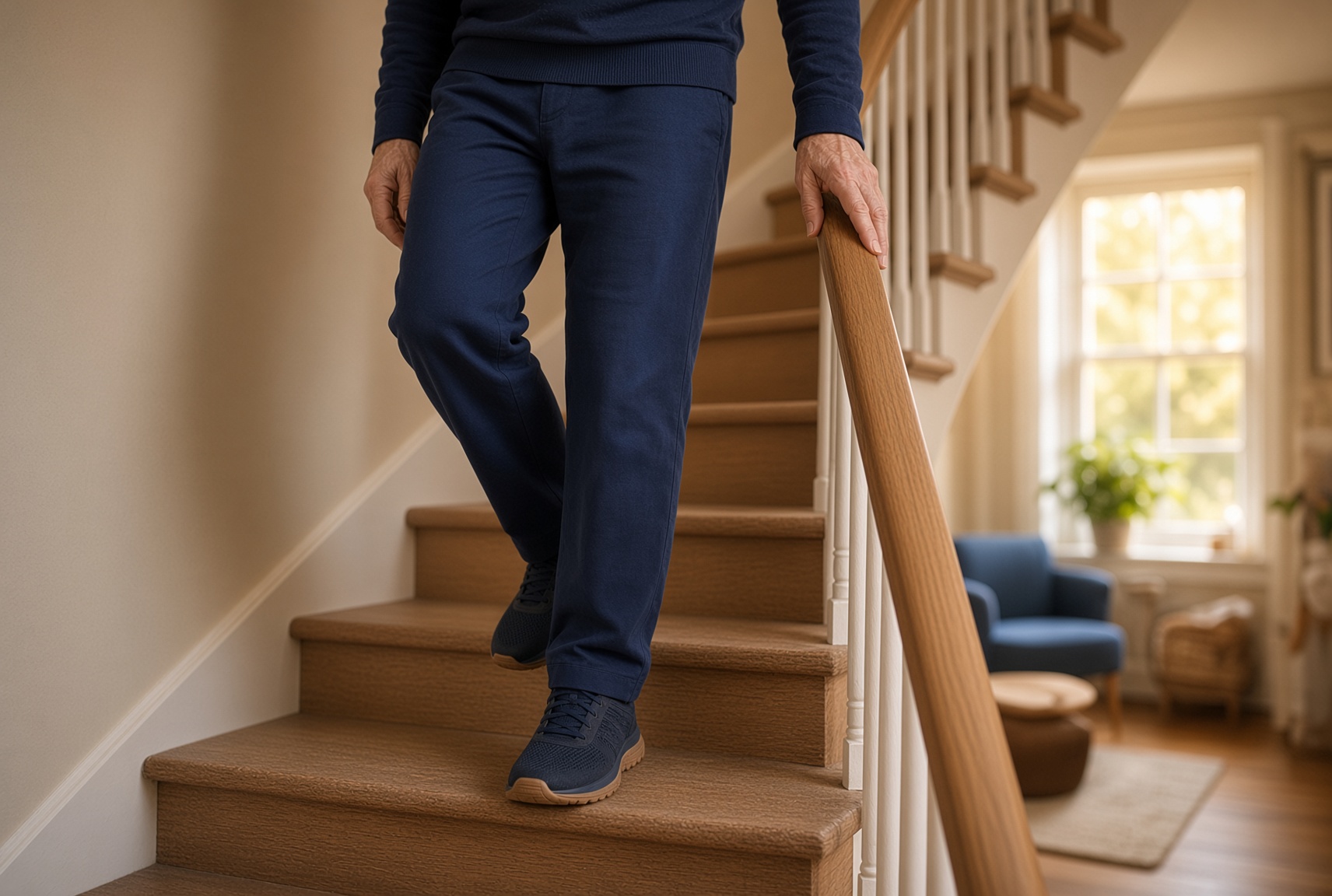
- Going up: step up with your stronger leg first, then bring the sore leg to meet it on the same step.
- Going down: step down with the sore leg first, then bring the stronger leg down to meet it.
Here’s why it works. Going up, the leading leg does the lifting. Going down, the leg that stays behind does the braking. Either way, this pattern gives the hardest job to your stronger leg.
And use the rail. Reaching for the rail isn’t a sign of defeat. It’s a tool that shares the load so you can keep using stairs, and staying active on stairs matters for keeping your legs strong.
This one change won’t answer every question about your knee. It’s a starting point that takes pressure off while you figure out which of those three knees you’re dealing with. The chair, the stairs, and what to change over the next seven days are where we’ll go next, together.
Join Me Live: Why Your Knee Doesn’t Trust the Stairs
If this sounds like your knee, I’d love to have you at my free live webinar.
Wednesday, October 28 · 6:30–7:00 PM PT · Online · Free to attend
In 30 minutes, we’ll cover:
- Why going down is the test, not the walk, and the three knees that feel the same
- The short list of signs that mean don’t wait, and the relief of not being on it
- Chair, stairs, and the next 7 days: three things you can change this week
Bring your questions. We’ll finish with a live Q&A.
Registration takes under a minute, and there’s no cost to attend.
Questions before then? Call 778-215-9310 or visit www.drcaryyurkiw.com. I’d be glad to help you take the next step.
Dr. Cary Yurkiw, DC
This article is general education, not medical advice, and does not diagnose any condition. It does not claim to cure, heal, eliminate, or reverse knee pain or arthritis. If your knee is locked and will not straighten, is hot and swollen with fever, or gave way after a twist, seek in-person care immediately.